By Noha El-Ghobashy and Olatunji Ayimora
Across sub-Saharan Africa, progress has been made in expanding access to medical oxygen — a vital intervention for COVID-19, pneumonia, maternal care, and surgical procedures. But there’s a dangerous blind spot in our oxygen infrastructure that continues to grow quietly and dangerously: the recertification of high-pressure gas cylinders.
While medical oxygen plants and concentrators have received donor attention, the cylinders that transport and store oxygen are too often neglected. These cylinders operate under intense pressure (up to 300 bar), and international safety standards require that they be inspected and recertified every five years to ensure structural integrity. When neglected, these cylinders can corrode internally, develop leaks, or rupture under pressure — posing severe risk to filling plant operators, patients, hospital staff, and surrounding communities.
Anecdotal evidence from industry insiders suggests that a significant majority of medical oxygen cylinders in sub-Saharan Africa are overdue for recertification, especially in countries like Nigeria, Kenya, and Ethiopia where maintenance infrastructure is scarce or nonexistent. In Nigeria, only two facilities — operated by multinational gas firms — offer proper cylinder recertification, and both are commercially inaccessible to most third-party cylinder owners. In Kenya and Ethiopia, no certified maintenance facility could be identified in recent assessments.
Although there is no public data yet to quantify the exact percentage, the lack of widespread infrastructure, regulation, and awareness make it plausible that thousands — potentially tens of thousands — of cylinders are in unsafe condition.
This is not just a regulatory oversight; it is a public safety threat.
If an uncertified oxygen cylinder fails during filling, transport, storage, or patient use, the consequences could be catastrophic:
The irony is that these outcomes are entirely preventable. Recertification is a low-cost intervention that dramatically extends the lifespan of a cylinder — often cheaper than replacement and far safer than running blind.
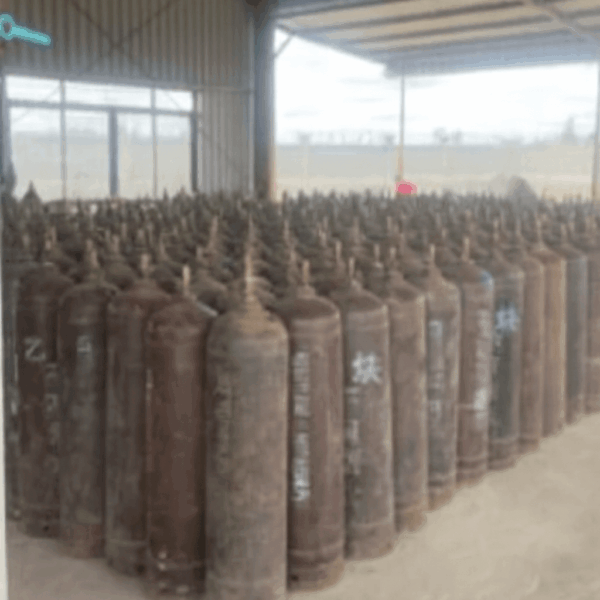
A storage space with weathered oxygen cylinders, with worn exterior paint and visible rust
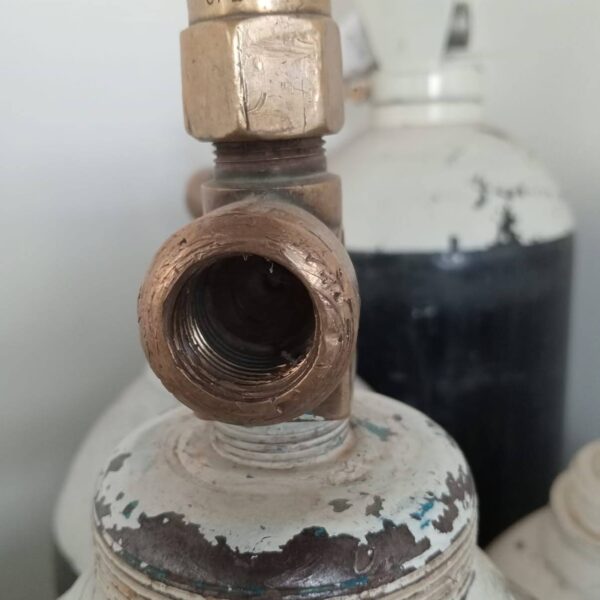
A close-up of a worn, threaded valve opening of an oxygen cylinder
A storage space with weathered oxygen cylinders, with worn exterior paint and visible rust
A close-up of a worn, threaded valve opening of an oxygen cylinder
Failing to address this infrastructure gap threatens to undo years of progress in Africa’s oxygen scale-up efforts. If a single cylinder explodes in a hospital setting, the human and political cost could be devastating. Even more insidiously, unsafe cylinders undermine trust in oxygen delivery systems — making providers hesitant to use them, and governments reluctant to invest further.
This is more than a technical problem. It’s a public health emergency waiting to happen.
The good news is that the solution is within reach and economically viable. A single maintenance workshop, with the right equipment and trained personnel, can recertify 50 cylinders per day — enough to serve a regional hub or metropolitan area. With an investment of $400,000 to $500,000 per facility, such a center can inspect, hydrotest, clean, and safely recondition cylinders of all gas types, not just oxygen.
This isn’t just about safety. It’s about sustainability and cost-efficiency. Recertifying a cylinder costs a fraction of buying new ones — yet extends its usable life for another five years. For countries trying to build resilient health systems with limited budgets, this is smart economics.
We call on governments, donors, development partners, and the private sector to act on this urgent, overlooked issue. Specifically:
Let’s not wait for a tragedy to remind us that safety is not optional in medical gas delivery. If we are serious about building strong health systems, then every link in the oxygen supply chain — including the steel cylinder itself — must be built on safety, compliance, and care.
If you’re interested in supporting this initiative, partnering on pilot sites, or learning more about our analysis, please get in touch.
Victor is a senior management executive backed by 15 years of experience in startups, FMCG, logistics and tech. An expert in Investor relations, Equity funding, board management, sales, finance, operations strategies and training. Victor possess demonstrated success of starting new business, developing existing business and motivating teams to consistently exceed targets. He excels in driving commercial strategies that markedly increase revenue and market share. His analytical acumen and profound industry knowledge underpin his track record of business leadership, transformation, strategic leadership and growth.
Victor is a senior management executive backed by 15 years of experience in startups, FMCG, logistics and tech. An expert in Investor relations, Equity funding, board management, sales, finance, operations strategies and training. Victor possess demonstrated success of starting new business, developing existing business and motivating teams to consistently exceed targets. He excels in driving commercial strategies that markedly increase revenue and market share. His analytical acumen and profound industry knowledge underpin his track record of business leadership, transformation, strategic leadership and growth.
Kevin is a seasoned business development professional with over a decade of experience driving business growth and operational excellence. His expertise spans a range of critical areas, including strategic planning, management, and operational execution. He possesses cross-functional skills in project development and growth initiatives, key account management, and portfolio management. This comprehensive skillset allows him to effectively contribute to various facets of business development, from initial project conception to ongoing portfolio optimization
Henry Aniago has 10 years of sales experience in the pharmaceutical industry. He is currently the Sales Associate for Oxygen Hub in the North-West region of Nigeria. Prior to joining Oxygen Hub, Henry worked as a Sales Associate in Sevier pharmaceutical and as a territory manager in Shelf Life Nigeria. He holds a bachelor in pharmacy degree and a Masters in Industrial Pharmacy from Ahmadu Bello University.
Sarah Jackson: is a Chartered Management Accountant with an impact investment background in Africa. Sarah spent 9 years working for the Verdant Frontiers Group leading the finance and legal side of operations in Africa, analysing investment opportunities and leading the groups consulting company, supporting investors in Ethiopia to transition their companies from the entrepreneurial to the corporate phase. Prior to that Sarah worked for the African Institute for Mathematical Sciences Next Einstein Initiative, a non-profit establishing post-graduate Mathematical Sciences institutes across Africa.
Christopher Okoye is the Sales manager for Oxygen Hub. He is a pharmacist with over 10 years of experience in Healthcare services, Pharma Sales, Key Account Management and Business development. He has worked with several multinationals and Start-up Pharma companies such as mPharma, GSK and Swipha. His most recent role was Wholesale Country Lead Nigeria at mPharma. Christopher holds a B.Pharm. degree from Ahmadu Bello University and a Graduate certificate in Management from Nigeria Institute of Management (Chartered).
The Oxygen Hub Team
Emmanuel is COO of Oxygen Hub. His most recent role was Vice President at mPharma. He has extensive commercial and operational leadership experience in several industries including engineering & technology, energy, healthcare and health-tech solutions across Sub-Saharan Africa. Emmanuel holds a BS Physics degree from University of Cape Coast, MS Physics from University of Massachusetts and Advanced Management Programme from IESE Business School
Leyou Tameru is Oxygen Hub’s Legal Advisor. She is an independent arbitrator and expert in
Africa focused international Arbitration. She advises governments and international government
organizations on investment and policy matters, such as serving as an expert in the drafting
process of the African Continental Free Trade Area protocols, ICSID rules amendment process
and providing contract and pre-dispute negotiations on large government contracts. Leyou is a
Court Member of the International Court of Arbitration at the International Chamber of
Commerce (ICC) in Paris (France) and is also on the list of arbitrators in a number of centers
such as the LCIA in London (UK), SHIAC in Shanghai (China), CRCICA in Cairo (Egypt) and
MARC in Port Louis (Mauritius).
Kimunga Kariuki is the Kenya Country Manager. He has over 8 years experience in start-up in the Kenyan Market with vast experience in product development, customer acquisition, as well as partner engagement and operations. Kimunga is passionate about problem solving for the African continent . He holds a degree in Commerce and a MSc in Operations & Technology management from the University of Nairobi.
Nnamdi is the founder and Group Chief Executive Officer of Interkel Group and has taken the company from its humble beginnings over 3 decades ago to being one of the most diversified indigenous construction and engineering companies in Nigeria and sub Saharan Africa.
Currently ITT’s CEO and the Interim CEO of Oxygen Hub , Noha previously led ITT’s product development, deployment strategy, and engagement with the technology-for-development ecosystem.
Strive is a businessman and philanthropist. He is the founder and executive chairman of the telecommunications company Econet Global.
Shashi Buluswar is the founder of the Institute for Transformative Technologies, and the chief architect of the largest electrification and natural sanitation infrastructures in the world.
Madji is a seasoned entrepreneur and senior business executive. She has designed numerous programs and initiatives to strengthen the private sector, drive policy changes and build partnerships.
Amod Kher is passionate about solving real world and business problems that impact the lives of millions of people. Amod has decades of business leadership spanning commercial, operational and product management expertise for medical products.
Kalkidan is a highly skilled and accomplished professional with over 5 years of diverse experience in the healthcare and technology industries, with a specific focus on women’s health. She excels in project management, strategic planning and team leadership, and has a proven track record of success in both the non-profit and private sectors.
Shreenal is currently the CEO of Oxygen Hub. Most recently, she held several senior positions at Jumia, Africa’s largest e-commerce business listed on the NYSE. At Jumia, she led the Food Delivery business to become the fastest growing category across the Group, reporting +25% year-over-year sales across 10 markets. Prior to Jumia she co-founded a digital marketing startup for SMEs, led a family-owned business, and drove the East Africa coffee and dairy strategyat TechnoServe. She has a bachelor’s from the University of Melbourne. She is a trained Latin ballroom dancer and a YALI Obama fellow.
Olatunji comes with two decades of experience in production and maintenance operation management. Mainly in manufacturing, industrial gas, and oil and gas industries. Olatunji holds a master’s in Operation and Production Management from the University of Lagos, bachelor’s in Petroleum Engineering from the University of Port Harcourt, and Higher National Diploma in Electrical Engineering from Yaba College of Technology, Lagos. Olatunji is a registered engineer with the Council for the Regulation of Engineering in Nigeria (COREN) and member of Nigerian Society of Engineers.
As Chief Scientist at ITT, Roger is responsible for ensuring the scientific rigor of the Institute’s pipeline of innovative technologies to reduce global poverty. He also leads research on strategic interventions in the fields of sanitation, agriculture and water security, to enable long-term well-being of human society. He is an author of the 50 Breakthroughs report that identifies critical scientific and technological advances needed for global development (50breakthroughs.org). Roger’s professional experience spans from scientific research in laboratory and field sites, to emergency humanitarian relief in refugee camps.
John is the region Finance Manager across the Oxygen Hub Ltd markets. He’s a seasoned finance professional with over 15 years of experience in Finance and Administrative Management. He has experience in the Telcom and Technology industry and has demonstrated strong business acumen both in leadership and strategic planning with proven results. He’s a Certified Public Accountant of Kenya (CPA-K), with his first degree in International Business Administration and later a master’s in Business Administration-Strategic Management.
Faizal Soobhany FCCA, overseas the finance function. With over 20 years of experience in financial management, reporting, compliance, and the implementation of internal controls across various industries, Faizal brings a wealth of knowledge and expertise to the team.
Njeri is a healthcare manager and critical care nurse with vast experience
in ICU, prehospital care and Healthcare/ Project Management. She has 13 years’
experience in the private health care sector and Non-governmental
organisation which implements projects for the government. She is currently the Kenya country manager for Oxygen Hub. Managing, supporting and monitoring oxygen hub franchisees, as well as implementing and improving the Kenya country strategy.
Harun is Special Project Manager for Oxygen Hub. He is an experienced project manager and
technology professional with a passion for success. Harun’s career journey has taken him
through the health sectors, where he worked in child immunization and sexual reproductive
health sectors. He has also worked with Non-Profits and Management Consulting companies to
gain valuable skills and knowledge, which have allowed him to excel in fast-paced
environments. Harun has a Bachelor of Science in Computer Science and a Masters Degree in
Project Management.
Kenaleone is a digital marketing & communications professional specialising in strategising, overseeing and writing content for various platforms. She has 10 years working experience and her skills include media training, strategic storytelling, digital brand management, research abilities and analytical skills which enable a 360° approach to the conceptualising, creation and dissemination of information for vast audiences on multiple platforms.
Ms Karuna Dookhan is the Administrative Coordinator at Oxygen Hub Ltd. She has over 5 years of experience working in the Administration field which has been acquired from both working in her country of origin and internationally. Karuna has a bachelor’s degree in business administration from the University of Mauritius coupled with a Master of Business Administration specializing in finance from the University of Wales, Cardiff.
Ijeoma is the Nigeria County Manager for Oxygen Hub. She has 9 years’ experience in Healthcare Advisory and Healthcare Financing and has worked for organizations such as PwC and IFHA. Ijeoma has a master’s in Public Health from University of Oklahoma Health Sciences Center
Ratana is Finance and Operations Director for Oxygen Hub, bringing over 10 years experience in corporate accounting and finance. Ratana holds a bachelor’s from Curtin University and membership in CPA Australia.
Etse-Hiwot is Ethiopia Country Manager for Oxygen Hub. She has over 10 years’ experience building and leading investments in numerous sectors including healthcare, construction, hospitality, manufacturing, mining, aviation and agribusiness. She has served as an advisor for private and public sector as well as NGOs in Ethiopia, Kenya and Rwanda.
Sanjay is Technical and Supply Chain Lead for Oxygen Hub and Vice President of ITT. Sanjay brings over a decade of experience in multi-disciplinary techno-commercial roles mainly in the energy, power products and automotive industries. Sanjay holds an MBA from the Faculty of Management Studies, University of Delhi, and a bachelor’s degree in mechanical engineering from the National Institute of Technology, Srinagar.
Fassil is the Finance and Operations Lead for Oxygen Hub. He is a financial consultant and a transaction advisor. Fassil has a solid track record of providing financial advice, management consulting, implementing governance systems, board reporting, and portfolio monitoring for clients. Fassil is a Chartered Financial Analyst from the CFA Institute, and a member of the CFA Society of East Africa.
Herma is Strategy and Business Development Lead for Oxygen Hub. She has extensive experience in business advisory with a focus on healthcare in Sub Saharan Africa. She has supported and help shape organizational strategies of government agencies, NGOs, private sector, and donor organizations. Herma holds a bachelor’s from Brown University and a master’s in Public Health from Columbia University.
Effeson has over 15 years’ experience serving as an entrepreneur, investor and strategic advisor to companies based in East Africa. He has advised investors, start-ups, well established companies, incubators, and accelerators in many strategy, operations and financing related engagements. He holds a bachelor’s degree in Finance and Marketing from New York University’s Stern Business School.